Going for Housing Growth – Open for Feedback
On 18 June 2025, the Government released its Going for Housing Growth discussion document, seeking public feedback on proposed changes to the planning system aimed at easing New Zealand’s housing shortage. The consultation is now open, with submissions invited until 17 August 2025.
What’s Changing in Housing and Infrastructure Planning
The Going for Housing Growth Proposal is part of a wider reform programme, signalling potential changes in how housing growth is managed and how infrastructure to support it is funded. It also feeds into the development of a new resource management system, expected to replace the RMA by mid-2026. Read more: Making Sense of the RMA Reform
A Quick Overview: What Is Going for Housing Growth?
The initiative is structured around three pillars designed to significantly increase housing supply:
- Pillar 1: Freeing up land for urban development by removing unnecessary planning barriers
- Pillar 2: Improving infrastructure funding and financing to support growth
- Pillar 3: Providing incentives for communities and councils to support growth (to be consulted on later in 2025)
Together, these are intended to unlock more housing opportunities both within existing urban areas and on city fringes.

Pillar 1 – Freeing Up Land for Development
Pillar 1 proposes a range of planning reforms that build on the National Policy Statement on Urban Development (NPS-UD).
The focus is on enabling councils to provide for at least 30 years of housing capacity, using higher population growth projections than many currently apply.
Key proposals include:
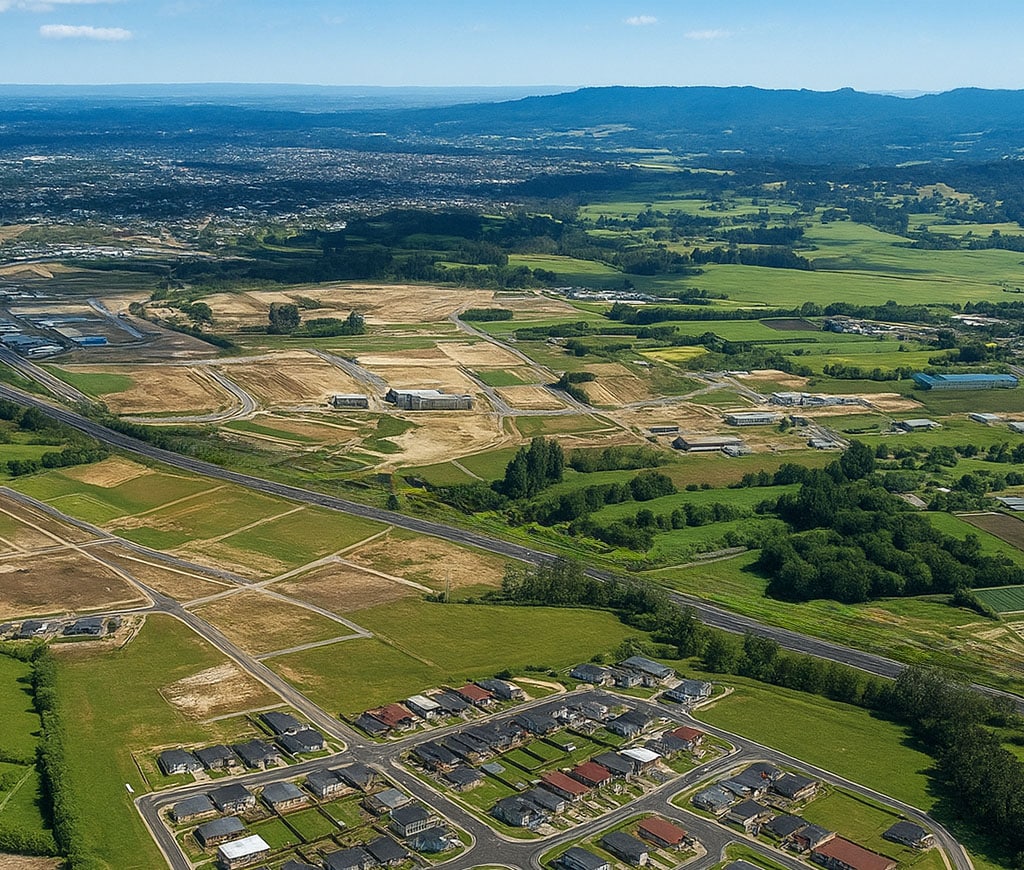
1. Supporting Out-of-Sequence Development: Currently, land must go through a plan change process before it can be developed—often held up by infrastructure limitations. Under the new proposal, land could become “development-ready” without a formal rezoning, provided certain infrastructure conditions are met.
The proposal also recommends removing rural-urban boundaries in plans, giving councils more flexibility to consider housing in new locations, even where it’s not anticipated in existing strategies.
This could speed up housing supply, especially in high-growth areas. However, infrastructure would still need to be funded and delivered in a timely and coordinated way.

2. Encouraging More Intensification: The current NPS-UD sets out intensification requirements around transport corridors and centres. The Government is concerned that some councils have treated height guidance (such as six-storey minimums) as strict limits. It is now looking to strengthen these provisions to ensure intensification opportunities aren’t unnecessarily constrained.
The proposed changes would also ensure lost housing capacity—due to hazards or special character overlays—is offset elsewhere. This may lead to more apartment-style housing in strategic urban areas, offering more lifestyle choice and efficient land use.
3. Enabling Mixed-Use Neighbourhoods: To support more walkable and liveable urban environments, the proposal includes new rules that would make it easier to include non-residential activities—like cafés or small shops—within residential neighbourhoods. These changes aim to support vibrant local centres and better integrate land use with existing cycling and walking infrastructure.
How these costs are shared between developers, councils, and communities will be critical. In some cases, new tools may help unlock otherwise stalled developments. In others, the costs may still limit feasibility, particularly in locations where the market cannot absorb the additional expense. As demonstrated by Watercare’s redzone areas, where capacity and infrastructure are limited, the planning framework may be in place but development could still be constrained if the existing systems don’t have capacity or if the bulk infrastructure is not available. Thus, how the new funding is rolled out will be key.

Auckland in Focus: Plan Change 78
In Auckland, this intensification agenda intersects with Plan Change 78 (PC78). Auckland Council has now finalised the city centre component of PC78, unlocking significant development capacity in the CBD.
The rest of the plan change may be withdrawn once the Resource Management (Consenting and Other System Changes) Amendment Bill is enacted, with Council required to notify a new plan change by 10 October 2025.
The replacement plan must at least match the housing capacity previously proposed—and is also expected to go further. New requirements will demand greater density around key City Rail Link (CRL) stations, including: Maungawhau (Mount Eden), Kingsland and Morningside.
This ensures planning rules align with major public investment in rapid transit, supporting walkable, higher-density neighbourhoods in prime urban locations.
> With PC78 evolving and key timelines set, Auckland developers need to act decisively. The opportunity to leverage the Medium Density Residential Standards is still available—but for a limited time.
What Happens Next?
Feedback gathered through this consultation will help shape the Government’s third phase of resource management reform. This includes developing new legislation to replace the Resource Management Act (RMA), expected by mid-2026. The proposals are being explored as part of this wider system shift, rather than as immediate changes to the existing planning framework.
Consultation on Pillar 3—focusing on incentives for councils and communities—will follow later in 2025.
Have Your Say
Anyone can make a submission. Whether you’re a developer, landowner, planner, or member of the public, this is an opportunity to provide feedback on how the planning system could change in the years ahead.
How to provide feedback:
- Online: hud.govt.nz/haveyoursay
- Email: Send your written submission to gfhg@hud.govt.nz
Submissions close on 17 August 2025.
If you’d like support preparing a submission or understanding how the proposals might affect your land or project, Cato Bolam’s experienced planning team is here to help.